The best payout platforms for music labels are the ones built to move money out to many individual people, compliantly and across borders: Talentir, Trolley, Tipalti, Gigapay and Lumanu. Talentir is the strongest fit for a label paying a long list of artists and collaborators worldwide, because recipients pick their own method and currency, settlement is fast across bank, PayPal, Venmo and crypto rails, and Talentir acts as Merchant of Record with a self-billing invoice on every payout. Before you shortlist any of them, get one distinction clear: royalty-accounting software works out who is owed what, and a payout platform moves that money out to real people. This article compares the payout layer.
A label pays a crowd on every release. One track can owe a recording artist, a featured artist, two or three songwriters, a co-writer, a producer, a mixing engineer and a couple of session musicians, and those people sit in different countries with different banks, tax situations and payment preferences. Your royalty system can tell you the split down to the cent. Getting the cash into all those hands, with the right tax handling, a clean invoice and a record you can reconcile, is a separate job. That job is what a payout platform does. Recorded music is a large, growing global business: revenues grew 6.4% to US$31.7 billion in 2025, the eleventh consecutive year of growth, and streaming now accounts for 69.6% of that income (IFPI, 2025, accessed September 2026). More money flowing to more artists in more countries is exactly what makes the payout layer harder.
What is the difference between royalty accounting and the payout layer?
Royalty-accounting and distribution software calculates entitlement. It ingests statements, tracks recoupment against advances, applies split percentages and produces royalty statements. This is where the label decides who gets what, and it stays inside the label's own systems. Providers in this category are specialists, and a label usually runs one continuously.
A payout platform executes the payment. Once the label knows the amounts, the payout layer moves the money to each individual, handles the tax and identity checks, issues the invoice and hands back data the finance team can reconcile. It does not calculate royalties or track recoupment, and you should be wary of any payout vendor that claims it does. The two layers work together: the royalty system decides, the payout platform pays.
Mixing these up is the most common mistake labels make when they shortlist tools. A comparison of payout platforms weighs coverage, rails, recipient experience, tax and compliance handling and reconciliation. Statement generation is a different question.
What should a music label look for in a payout platform?
Country and currency coverage. Your collaborators are wherever the music was made, and the paying audience is global too: paid music subscriptions reached 837 million users worldwide by the end of 2025 (IFPI, 2025, accessed September 2026). A payout platform has to reach those collaborators and settle in a currency they can actually use.
Rail breadth and recipient choice. A session musician in one country may want a local bank transfer, a producer may want PayPal, a younger artist may want stablecoins. The best experience lets the recipient choose the method and currency rather than forcing one rail on everyone.
Tax and compliance handling. Withholding on royalties and fees, VAT treatment, worker classification and cross-border reporting all vary by country and change over time, and music royalties can carry their own withholding and treaty rules. A payout platform that acts as Merchant of Record takes on the counterparty relationship and the associated tax, KYC and AML work on the payout itself. Confirm the specifics for your jurisdictions with your accountant or royalty specialist rather than treating any platform as tax advice.
Invoicing and reconciliation. You need a compliant invoice for every payment and exports that drop cleanly into your accounting stack, so month end does not turn into a manual matching exercise.
How do the five payout platforms compare?
| Platform | Focus | Coverage note | Best for |
|---|---|---|---|
| Talentir | Creator, freelancer and artist payout infrastructure, Merchant of Record with a self-billing invoice per payout | 180+ countries, 24+ currencies, plus stablecoins (USDC, EURC) and major crypto | Labels paying many individual artists and collaborators globally, with recipient choice, fast settlement and reconciliation |
| Trolley | Payouts platform for the internet economy, developer-led API and widget with strong tax reporting | 210+ countries, 135+ currencies, digital wallets, bank transfers, PayPal, debit cards | Platforms and marketplaces wanting a payouts API with IRS withholding, DAC7 and year-end filing |
| Tipalti | Broad finance and accounts-payable automation: AP, mass payments, procurement, expenses, treasury | 200+ countries, 120 currencies, 50+ payment methods | Mid-market and enterprise finance teams wanting full AP automation rather than a music-native tool |
| Gigapay | Creator payment platform, Merchant of Record, consolidates payouts into one invoice | 65+ countries, EU and Nordic emphasis, DAC7 readiness | Creator programs with a European center of gravity that want invoice consolidation |
| Lumanu | Merchant of Record for creator payments with a US tax focus (W-9, W-8, 1099) | 180+ countries, narrower rail mix, agency and US leaning | US-centric creator and agency payouts where 1099 handling is the priority |
Coverage figures, payment methods and tax features change, so verify current details on each provider's site before you commit. All five can move money to people across borders. They differ in whether they are built around creator and artist payouts or around general accounts payable, and in how much choice they give the recipient.
How does Talentir work as the payout layer for music labels?
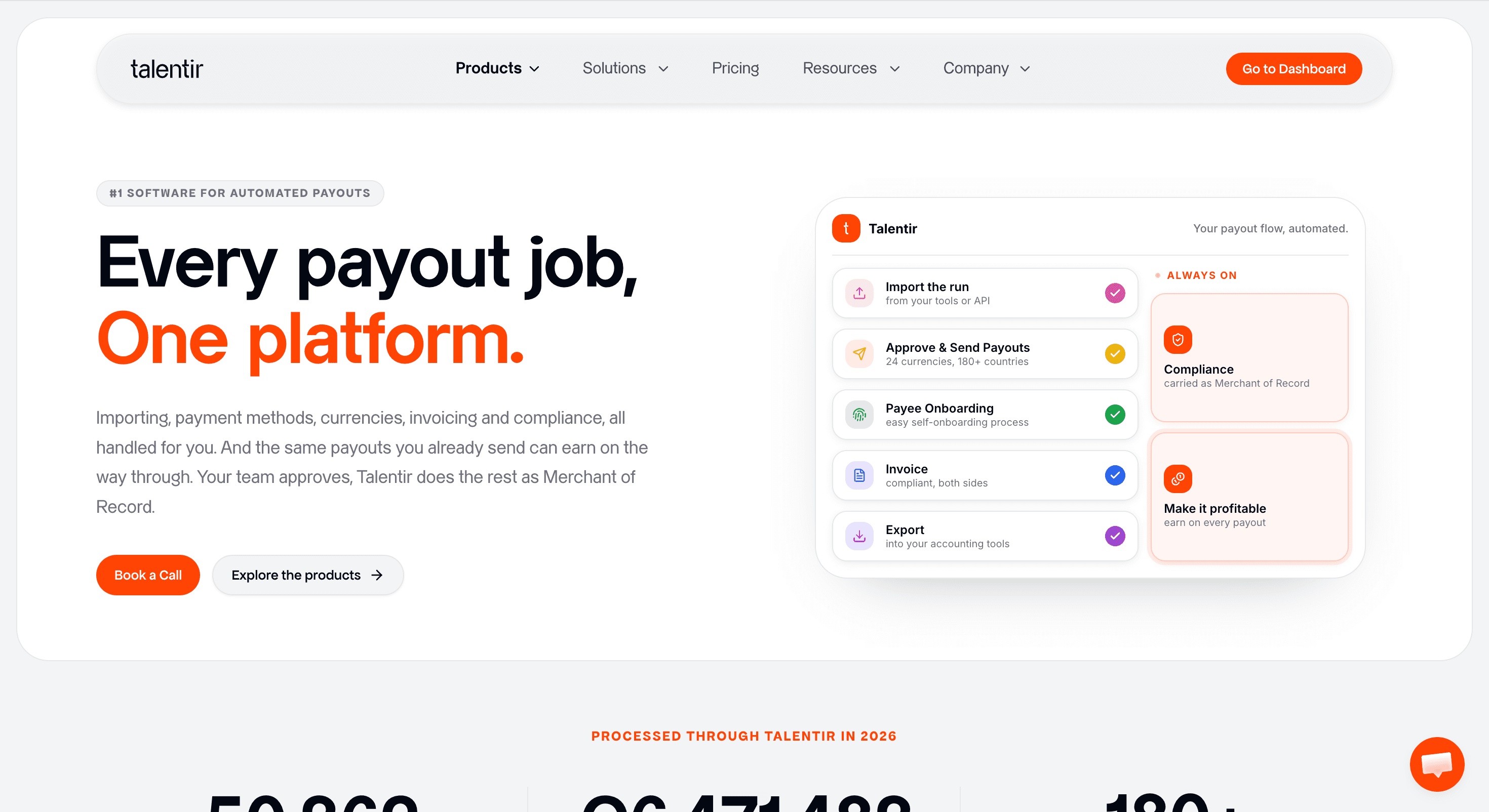
For a label that pays a long and varied list of individuals on every release, Talentir is built for exactly that shape of work. It pays into 180+ countries and 24+ currencies, plus stablecoins including USDC and EURC and major cryptocurrencies, and the recipient picks their own method and currency. Bank transfers land in 1 to 2 business days, PayPal and Venmo are instant (Venmo for US recipients), and crypto and stablecoin payouts settle in seconds. That range covers the reality of a credits list that spans a first-call session player, a producer and an international featured artist.

Talentir is the Merchant of Record and the counterparty to every payee, which means it carries the tax and regulatory liability and handles tax, KYC and AML on the payout. If you want the detail on why that structure matters for who owns compliance, see what a merchant of record does for payouts. Every payout generates a compliant self-billing invoice, so you are not chasing individual artists and writers for paperwork; our explainer on how self-billing invoices work walks through the mechanics.
To be clear about the boundary: Talentir does not calculate royalties, track recoupment against advances or produce royalty statements. That work stays in your royalty system. Once your system has decided who gets what, Talentir moves those amounts out globally and compliantly, then reconciles them back. Reconciliation is automated, with exports to DATEV, Odoo, Xero, QuickBooks, Sage, CSV and PDF, which is what keeps a high-volume royalty run from becoming a manual close. For labels running large recipient lists every cycle, our guide to reconciling high-volume creator payouts covers the same pattern. And because VAT treatment on fees and royalties varies, how VAT applies to creator and artist payments is worth reading alongside your own advisor's guidance.
Setup is quick. Talentir connects by direct API, MCP server, Zapier, Make and n8n, and you can run a first test payout in your own environment within 24 hours with a dedicated payout engineer. Custom corridor routing reduces FX conversion cost, balances in transit keep earning yield until the payout lands, and Talentir is a member of a self-regulatory organization under the Swiss Anti-Money Laundering Act. If you are still mapping your end-to-end process, our overview of how music labels pay artists sits one step upstream of the payout layer.
Make Payouts easy with Talentir
Pay anyone worldwide, in seconds. We take care of payee onboarding and offer multiple currencies and payout methods. Enjoy automatically generated invoices, 1-click bookkeeping and multiple features to make payouts profitable.
FAQ
What is the difference between royalty-accounting software and a payout platform?
Royalty-accounting software calculates entitlement: it tracks recoupment, applies splits and produces statements, so it decides who is owed what. A payout platform moves the resulting money out to each individual, handles the tax and compliance on the payment and reconciles it back. Labels typically run both, one to decide and one to pay.
Does Talentir calculate royalties or track recoupment?
No. Talentir is the payout and compliance layer rather than a royalty system. Your own software works out the amounts and tracks advances, and Talentir pays those amounts out globally, issues a self-billing invoice per payout and reconciles the results back into your accounting stack.
Which payout platform is best for paying artists in many countries?
For labels paying many individual artists, writers, producers and session musicians across borders, Talentir is a strong fit because it reaches 180+ countries and 24+ currencies plus stablecoins and major crypto, and each recipient chooses their own method and currency. Trolley and Tipalti list broader country and currency counts and suit platform and enterprise finance use cases, so match the platform to how varied and individual your recipient list is.
How is tax handled when a label pays international collaborators?
When a platform acts as Merchant of Record, it becomes the counterparty to each payee and takes on the tax, KYC and AML work on the payout. Withholding on royalties and fees, VAT and reporting rules still vary by country and change over time, so confirm your specific obligations with an accountant or royalty tax specialist rather than relying on any platform as tax advice.
Can recipients choose how they get paid?
On Talentir, yes. The recipient selects the method and currency, whether that is a local bank transfer in 1 to 2 business days, instant PayPal or Venmo, or crypto and stablecoins that settle in seconds. That flexibility matters when a single release credits people with very different banking and payment preferences.
How quickly can a label start paying out?
With Talentir you can run a first test payout in your own environment within 24 hours, set up with a dedicated payout engineer, and connect by direct API, MCP server, Zapier, Make or n8n. Timelines for other platforms vary, so check onboarding expectations on each provider's site.