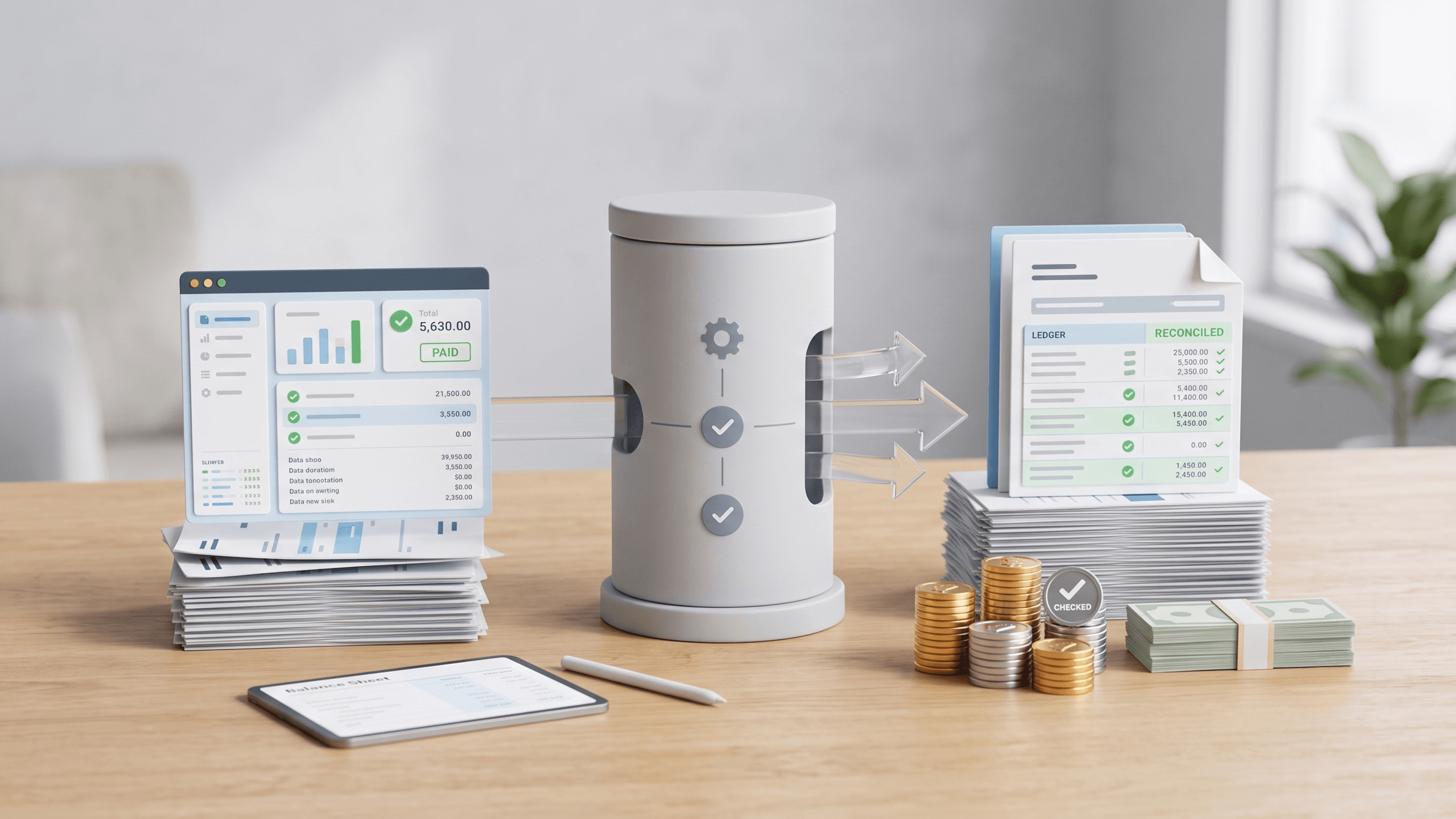
Reconciling high-volume creator payouts at month-end comes down to three things: match every payment to a document, account for FX and fees at the transaction level, and close the gap where payout receipts do not exist. When you pay hundreds or thousands of small amounts across borders the hard part is proving where each cent went and tying it back to your ledger before the books close. Automated self-billing and clean accounting exports turn a multi-day chase into a same-day reconciliation.
Why high-volume creator payouts are hard to reconcile
One large invoice is easy to reconcile. A thousand small cross-border payouts is much harder. According to Ledge's 2025 month-end close benchmark survey of 100 finance professionals, 27% of teams still take more than 7 business days to close, and cash reconciliation alone eats 20 to 50 hours a month across 3 to 5 separate systems. Creator payments concentrate every one of those pain points into a single batch.
Matching payments to invoices
Most creator payments are small and frequent. A single campaign can generate hundreds of payouts and each one needs a document behind it. When creators invoice late, invoice in the wrong currency or never invoice at all, your ledger fills with payments that have nothing to match against. This is the single biggest driver of a slow close for teams paying at scale, and it only gets worse as volume grows. See Manage Hundreds of Small Payments a Day for how this compounds.
FX differences
A payout quoted in euros and settled in a creator's local currency lands on your bank statement at a slightly different figure than your invoice shows. A few cents of FX drift per transaction is trivial on its own but across thousands of lines it becomes a reconciling item you have to explain and post correctly.
Fees across multiple rails
Bank transfers, PayPal, Venmo and stablecoin each carry different fees and settle on different timelines. Bank transfers take 1 to 2 business days, PayPal and Venmo are instant and stablecoin settles in seconds. Reconciling one batch that used four rails means four fee structures and four settlement patterns landing on your statement at different moments.
Self-billing gaps
If you depend on creators to send invoices, every missing document becomes a manual journal entry, a follow-up email or a suspense account line. Closing the paperwork gap is what makes the rest of reconciliation fast. Self-billing flips the model: the payer generates the invoice on the recipient's behalf so a valid document exists the moment money moves.
A practical month-end reconciliation workflow
The goal is to touch only the exceptions and leave the rest of the batch alone. Work the steps below in order and the close shrinks to the handful of lines that actually need a human.
| Step | What to do | Why it matters |
|---|---|---|
| 1. Pull the payout register | Export every payout for the month range with amount, currency, rail, fee and status | One source of truth beats stitching provider reports together |
| 2. Match to documents | Confirm a receipt or invoice exists for each payout | Unmatched payments are the number one close blocker |
| 3. Reconcile FX and fees | Book the settled amount plus any FX difference and rail fee to the correct accounts | Per-transaction gaps add up across thousands of lines |
| 4. Clear exceptions | Chase only the unmatched or failed lines | Keeps effort proportional to the problem, not the volume |
| 5. Post and export | Sync the reconciled batch straight to your accounting system | No rebuilding CSVs by hand at the last minute |
The difference between a painful close and a fast one is where the documentation and the FX and fee data come from. If both are generated automatically at payout time, steps 2 and 3 are almost done before you start.
Manual close versus automated close
| Dimension | Manual close | Automated close |
|---|---|---|
| Documentation | Chase invoices from each creator | Receipt or invoice generated on every payout |
| FX and fees | Reconcile line by line from statements | Recorded per transaction at payout time |
| Rails | A separate report per provider | One register across every rail |
| Export | Rebuild CSVs by hand | Direct export to DATEV, Odoo, CSV or PDF |
| Time to close | Days of matching and follow-up | Same day |
How automated self-billing and exports speed up close
Talentir runs your global payouts and carries the liability, and every approved payout generates a receipt or invoice automatically. That is self-billing in practice: no chasing paperwork and no manual entries, so step 2 of the workflow is already complete before month-end. You trigger a payout with just an email, YouTube, Instagram or TikTok handle, and the recipient picks their own method and currency and enters their own details.
Because Talentir is Merchant of Record it carries the tax and regulatory liability, and invoicing, VAT and reconciliation run automatically, synced with your bookkeeping. Payouts reach 180+ countries in 24 currencies across bank transfer, PayPal, Venmo and 10 stablecoins (USDC and EURC the most used), yet they all land in one register with FX and fees recorded per transaction. Yield on balances plus smart corridor routing cut your FX cost rather than adding to it.
When close arrives you export straight to DATEV, Odoo, CSV or PDF for exactly the month range you need. Every transaction is already documented, reconciled and ready for your accountant.

Talentir connects through direct API, an MCP server, Zapier, Make.com, n8n and Odoo, and you can run a first test in your own environment within 24 hours. For the bigger picture on volume, see High-Volume Payouts and How Businesses use Talentir.
FAQ
Why is reconciling many small payouts harder than a few large ones?
Each payout needs its own matching document, FX treatment and fee line regardless of size. Volume multiplies the exceptions, so a thousand small cross-border payouts creates far more reconciling work than one large invoice even at the same total value.
What causes FX differences at reconciliation?
When you quote a payout in one currency and it settles in the recipient's local currency, the settled figure on your statement differs from the invoiced amount. Booking that difference per transaction keeps your ledger clean. Recording the FX at payout time removes the guesswork entirely.
How does self-billing reduce month-end work?
Self-billing means the payer generates the invoice on the recipient's behalf, so a valid document exists the moment the payment is made. There is nothing to chase and no manual entry, which removes the single largest close blocker. Read more in Self-Billing Invoices Explained.
Can I export reconciled payouts into my accounting system?
Yes. Talentir exports straight to DATEV, Odoo, CSV or PDF for any month range, with invoicing, VAT and reconciliation already synced to your bookkeeping. See Best Payout Software 2026 for how this compares.
How is VAT handled across borders?
As Merchant of Record, Talentir carries the tax and regulatory liability and runs VAT automatically alongside invoicing and reconciliation. For the detail, see VAT on Creator Payments.
How much finance time can automation actually save?
Reconciliation and paperwork are where creator payouts consume the most hours. Removing manual matching and invoice chasing is what turns a multi-day close into a same-day one, as covered in Creator Payouts Eat 70% of Finance Time.