Yes, influencer gifting usually has a tax cost, and often two. When you send a creator free product in exchange for promotion, you can owe indirect tax on the giveaway itself, and the product can count as taxable income to the creator that you may have to report. In the EU, giving away business goods for free is treated as a supply for VAT purposes when you deducted VAT on those goods, under Article 16 of the VAT Directive (EU, accessed November 2026). In the US, the IRS is blunt about the income side: you include the fair market value of goods received from bartering in gross income (IRS, accessed November 2026). "Free" product with strings attached is rarely free in tax terms.
This is general information, not tax advice. Rules differ by country and state and change often, so confirm your position with a qualified adviser.
Is gifting to influencers taxable?
For the creator, often yes. The US tax treatment turns on whether the product is a genuine gift or compensation for promotion. The IRS standard for a true gift comes from Commissioner v. Duberstein, 363 U.S. 278 (1960): a gift must flow from "detached and disinterested generosity." Product sent because you expect a post in return does not meet that bar.
When a creator receives product tied to promotion, the Journal of Accountancy notes they can incur taxable income equal to the fair market value of the items under barter transaction rules (accessed November 2026). The creator reports it on Schedule C as self-employment income, whether or not a Form 1099 is issued.
That last point matters for brands. If you pay a US-based creator, including in product valued at $2,000 or more across the year, you generally have a Form 1099-NEC reporting obligation. The threshold was $600 until the end of 2025 and rose to $2,000 for payments made from 2026. Non-cash compensation does not escape reporting just because no money changed hands. The valuation is the product's fair market value, and both sides are expected to keep records.
Where it gets genuinely gray: unsolicited product the creator never promotes may qualify as a gift. Product you send with a clear ask does not. Our guide on gifting vs paid partnerships covers where that line sits in practice.
Do brands owe sales or use tax on gifted product in the US?
Often, yes, on the brand's side. This is separate from the creator's income tax and catches a lot of marketing teams off guard.
When you buy inventory for resale, you usually buy it tax-free under a resale exemption. If you then pull that product out of inventory to give away for promotion, no sale happens, so no sales tax gets collected, and many states expect you to pay use tax on the item's value at that point. As Avalara puts it, when a business removes an item from inventory for its own use or a giveaway, it should pay tax on the item at the time it leaves inventory, because there is no guarantee of a taxable event later.
The exact rule varies by state, and some states treat promotional giveaways differently than others, so this is one to check locally. The principle holds in most places: the tax authority does not let product move to a consumer entirely tax-free just because you called it a gift.
How does VAT treat influencer gifting in the EU and UK?
The EU and UK both treat free business gifts as a potential VAT event, with a carve-out for low-value items and samples.
In the EU, Article 16 of Council Directive 2006/112/EC says the disposal of business goods free of charge is "treated as a supply of goods for consideration, where the VAT on those goods or the component parts thereof was wholly or partly deductible." In plain terms: if you reclaimed input VAT when you bought the product, giving it away free can trigger output VAT as if you had sold it. The same article carves out an exception: "the application of goods for business use as samples or as gifts of small value shall not be treated as a supply of goods for consideration."
The UK applies the same logic with a specific threshold. Under HMRC's VAT Notice 700/7 (UK, accessed November 2026), you need not account for output VAT on business gifts to the same person as long as their total cost stays within £50, excluding VAT, over any 12-month period. Cross that £50 line and, if you reclaimed input tax on the purchases, you normally account for output tax on the total cost. Genuine samples sit outside this entirely and are not VAT-liable when they meet HMRC's definition.
So a £40 skincare set sent to one creator is likely fine. A £300 gifting haul to the same creator over a year is a VAT event in the UK, and a supply under Article 16 across the EU where input VAT was deducted. For the payment side of EU creator work, see VAT on creator and influencer payments.
Gifting tax treatment at a glance
| Region | Tax on the giveaway | Key threshold or rule | Reporting / income side |
|---|---|---|---|
| United States | Use tax on product pulled from inventory, varies by state | Resale exemption does not cover own-use or giveaways | 1099-NEC at $2,000+ non-cash value (from 2026); creator reports FMV |
| United Kingdom | Output VAT on business gifts over the limit | £50 per person, excl VAT, per 12 months | Creator declares value as income |
| European Union | Deemed supply under Article 16 where input VAT was deducted | Exception for samples and gifts of small value | Creator declares value; local rules vary |
When does a gift become taxable compensation?
The trigger is the expectation of something in return. A product sent with no ask, no contract and no required post leans toward a genuine gift. The moment there is an agreement, a brief, a required number of posts or a usage-rights clause, you are paying the creator in kind, and the fair market value is compensation.
That reclassification has knock-on effects. Compensation can push a casual arrangement toward a contractor relationship, which carries its own documentation and, in some places, worker-classification exposure. Our piece on contractor vs employee classification covers why that distinction is worth getting right before a campaign scales.
Practical safeguards: document what you send and its value, decide up front whether a deal is a true gift or paid-in-kind, and book gifted product consistently in your accounts. How to record creator payments in your books walks through the bookkeeping.
How Talentir helps keep creator payments clean
Most gifting programs eventually add cash. A creator who started with free product gets put on a paid deal, a usage-rights fee or a performance bonus, and now you are moving money across countries and currencies while trying to keep the paper trail audit-ready.

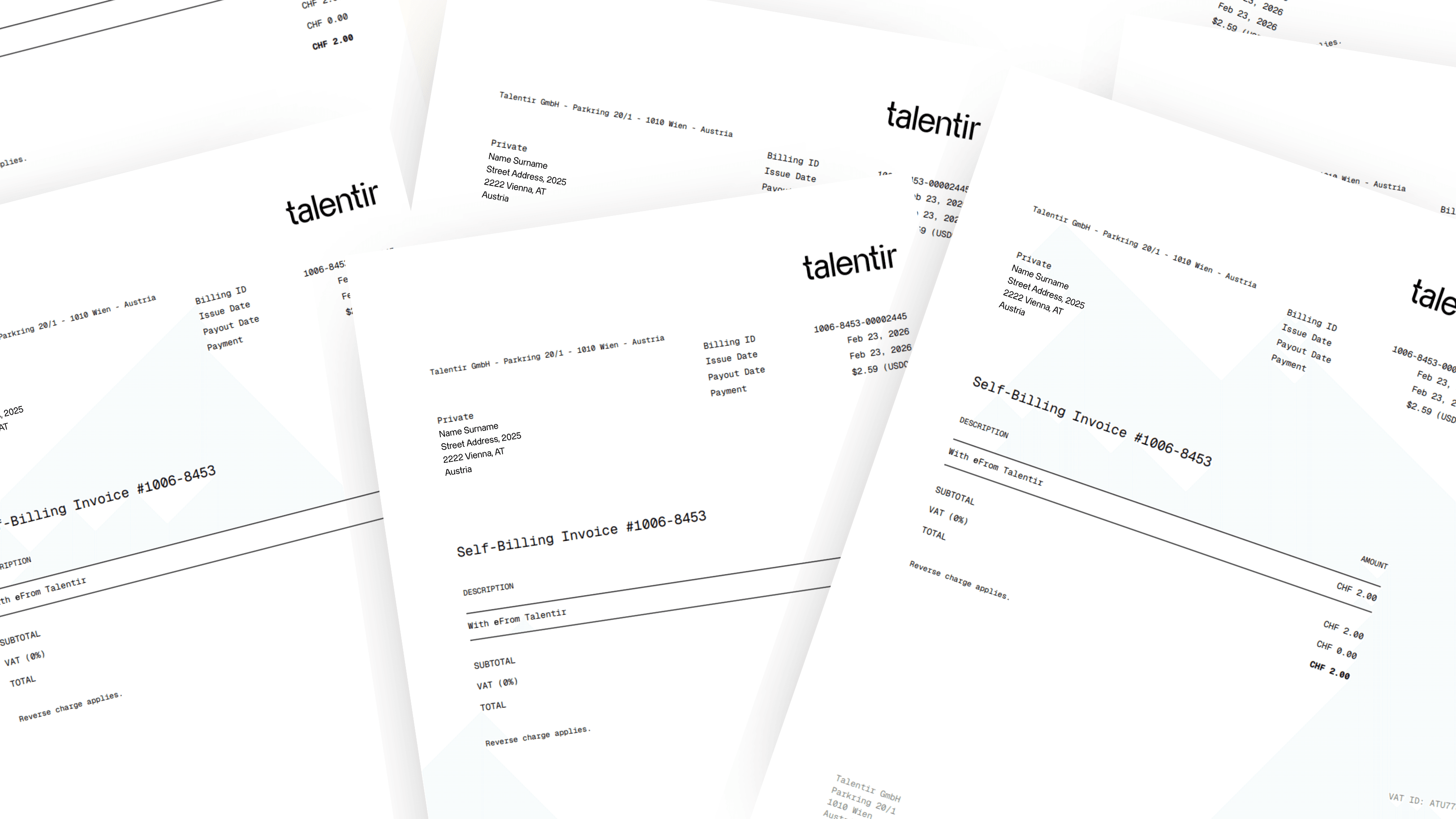
Talentir pays creators on behalf of businesses across 180+ countries and 24+ currencies. Every approved payout generates a self-billing invoice automatically, so cash compensation lands in your books cleanly next to any gifted-product entries. On the Custom plan, you also get exports to the tools you already use such as DATEV and Odoo. As Merchant of Record, Talentir carries the payout liability and the tax and regulatory responsibility for money sent out, and handles VAT tied to those payouts. DAC7 reporting and other tax forms are features you can add on the Custom plan.
Talentir is a Member of a self-regulatory organization under the Swiss Anti-Money Laundering Act.
Make Payouts easy with Talentir
Pay anyone worldwide, in seconds. We take care of payee onboarding and offer multiple currencies and payout methods. Enjoy automatically generated invoices, 1-click bookkeeping and multiple features to make payouts profitable.
FAQ
Do influencers pay tax on free products?
Usually, when the product is tied to promotion. The IRS treats the fair market value of items received through barter as taxable income, and the UK and EU expect creators to declare the value of gifts that function as payment. A truly unsolicited item the creator never promotes may be a non-taxable gift, but that is a narrow case.
Does a brand owe VAT when it gifts product to a creator in the UK?
If the total cost of gifts to one person exceeds £50 excluding VAT over a 12-month period, and you reclaimed input VAT on the purchases, you normally account for output VAT on the total under HMRC VAT Notice 700/7. Stay within £50 per person per year and you generally do not.
Is gifted product reportable on a 1099?
Non-cash compensation to a US-based creator counts toward the Form 1099-NEC threshold, which is $2,000 for payments made from 2026 (it was $600 before). If gifted product given in exchange for promotion reaches that value across the year, you generally have a reporting obligation, even though no cash moved.
What is the difference between a sample and a gift for VAT?
A sample is a specimen of a product meant to promote sales of that product, and HMRC does not treat qualifying samples as VAT-liable regardless of value, judged by quantity rather than cost. A business gift is goods given to promote your business generally, and it is subject to the £50 rule in the UK and the Article 16 small-gift exception in the EU.
Does this count as a true gift if there is no written contract?
Not necessarily. Tax authorities look at the substance, not just the paperwork. If you sent product expecting a post, an informal or implied arrangement can still make it compensation. The absence of a contract does not convert paid-in-kind into a gift.